
The Mystery Behind the Mantis Shrimp’s “High-Speed Color Recognition System”
Date: February 17, 2026
■ Introduction
In a previous blog post, we introduced the mantis shrimp’s incredible ability to perceive polarized light. This time, we will dive deeper into another remarkable feature of the mantis shrimp—its spectral function, or how it recognizes colors.
■ The Astonishing 12 Types of Photoreceptors
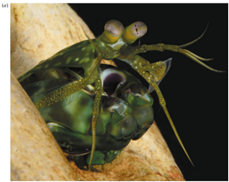
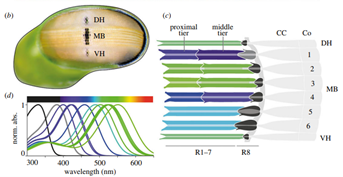
Humans have three types of photoreceptor cells (cones) — red, green, and blue — which we use in combination to recognize colors. In contrast, mantis shrimp are known to possess 12 different types of light-sensitive cells that can detect a broad range of wavelengths, from ultraviolet to infrared.
Because of this, mantis shrimp were long believed to possess “super color vision” capable of distinguishing many more colors than humans can. However, a 2014 study revealed a surprising finding.
■ The Truth: Not “Super Color Vision”?
In experiments by a research team at the University of Queensland, it was found that mantis shrimp cannot distinguish color differences of 12–25 nm — while humans can distinguish differences as small as 1–5 nm. This means that in actual color discrimination ability, mantis shrimp are inferior to humans.
■ So Why Do They Have 12 Photoreceptors?
What purpose do the 12 photoreceptors serve if not for superior color discrimination?
Research has shown that each of the mantis shrimp’s photoreceptors is tuned to detect just one specific color, unlike human vision, where multiple photoreceptor signals are compared and processed.
This means mantis shrimp do not “combine” information from different photoreceptors like humans do. Instead, each photoreceptor independently recognizes its color, allowing the mantis shrimp to skip extensive neural processing.
The advantage of this is processing speed. Human brains must perform complex comparisons across photoreceptors to recognize color. In contrast, mantis shrimp can recognize color immediately without such heavy computation — an advantage in capturing prey quickly.
■ Summary
The mantis shrimp’s spectral function is not superior simply because it has many photoreceptors. Rather, it is the combination of its unique, high-speed processing color recognition system and specialized brain structure that supports its survival strategy.
This teaches us the importance of optimal design tailored to specific needs.
Luceo applies insights gained through optical filter development and manufacturing to the design and production of various optical sensors and lens units. Please feel free to contact us for inquiries.
Figure Source:
Cronin TW, Marshall NJ. (2022). Colour vision in stomatopod crustaceans. Phil Trans R Soc B 377: 20210278.
https://royalsocietypublishing.org/doi/10.1098/rstb.2021.0278
We Meet Our Customers’ Needs with Proven Technology and Expertise!!!
★ Optical Sensor Systems & Lens Units
Custom optical sensors and lens units are available to meet your specific requirements.
High-Performance Polarizers Tailored to Your Needs — Available from a Single Sheet!!!
★ Polarizer POLAX
Custom (made-to-order) polarizers are available.
Retardation Films That Provide Constant Phase Difference Across an Ultra-Wide Wavelength Range!!!
★ Super Broadband Retarder SB-RETAX
Super Broadband Retarder SB-RETAX
Broadband Retarder B-RETAX
New — Residual Stress Inspection for Glass and Plastic Molded Products!!!
★ Fully Automatic Strain Inspection System LSM-9002LE
Fully Automatic Strain Inspection System LSM-9002LE
New — Comprehensive Measurement & Evaluation Service for Optical Filters, Glass, and Plastic Products
Simply send us your sample — we take care of the rest!!!
★ Measurement Services
Retardation Measurement / Surface Accuracy Measurement / Transmittance & Reflectance Measurement / Stress Distribution Evaluation
Contact Us:
https://www.luceo.co.jp/en/contact-us/